

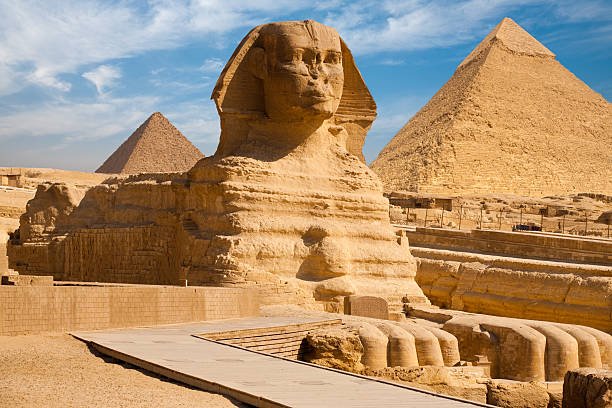
The Great Sphinx of Giza: Complete Travel Guide & History | Cheers Egypt Tours

The Great Sphinx of Giza: Complete Travel Guide & History | Cheers Egypt Tours
The Great Sphinx of Giza: History, Mysteries & Expert Travel Guide
Carved from the living bedrock of the Giza Plateau, the Great Sphinx has guarded the celestial threshold of the Nile Valley for over four millennia. Known to antiquity as Hor-em-akhet—Horus on the Horizon—this colossal hybrid of human intellect and leonine power represents one of the most enigmatic achievements of pharaonic civilization. For discerning travelers journeying across Egypt, standing before this monumental sentinel offers an unforgettable encounter with sacred ancient theology, forgotten desert restorations, and architectural majesty.
- The origins, identity, and Old Kingdom construction credited to Pharaoh Khafre.
- The legendary Dream Stele of Thutmose IV and ancient restorations.
- Strategic visitor perspectives from the Valley Temple and elevated viewing terraces.
- Complete travel itineraries connecting the Sphinx with our comprehensive guides to the Giza Pyramids Complex, the treasures within the Grand Egyptian Museum, and the royal necropolis of Saqqara & Djoser’s Step Pyramid.
Anatomy of a Colossus: Origin and Geological Mastery
Sculpted around 2500 BCE during the Fourth Dynasty, the Great Sphinx measures approximately 73 meters (240 feet) in length and 20 meters (66 feet) in height. Unlike the surrounding pyramids constructed from quarried stone blocks, the body of the Sphinx was carved in situ from a singular, stratified outcrop of nummulitic limestone. The softer bedrock layers formed the lion’s recumbent torso, while a denser geological stratum was sculpted into the iconic royal countenance, widely attributed to Pharaoh Khafre adorned with the ceremonial nemes headdress.
The Dream Stele: Royal Promise in the Desert Sands
Throughout Egyptian history, drifting desert sands frequently buried the monument up to its neck. Standing between the front paws of the beast is the famed Dream Stele, an upright red granite slab erected by Prince Thutmose (later Thutmose IV) during the Eighteenth Dynasty. While resting in the shade of the submerged colossus during a hunting expedition, the prince received a prophetic vision: the sun god promised him the unified crown of Egypt if he cleared the suffocating sands. Upon ascending the throne, Pharaoh Thutmose fulfilled his vow, inaugurating the first recorded state restoration project in recorded history.
“Look upon me, O my son Thutmose. I am your father, Hor-em-akhet… The sand of the sanctuary upon which I rest has covered me. Restore me, so that you may prosper.” — Inscription from the Dream Stele of Thutmose IV
The Valley Temple of Khafre: A Masterpiece in Megaliths
Immediately flanking the Sphinx enclosure lies the Valley Temple of Khafre. Built from colossal core limestone blocks faced with polished Aswan red granite, this temple features an architectural severity that contrasts brilliantly with the delicate reliefs of later eras. The temple was the sacred venue where the pharaoh’s body underwent the ritual Opening of the Mouth and purification before journeying up the stone causeway to the pyramid tomb.
Discerning Traveler Tips
- Best Angles for Photography: The elevated causeway viewing terrace on the eastern side offers the classic framing showing the Sphinx in the foreground with Khafre’s pyramid soaring behind it.
- Optimal Lighting Times: Visit between 07:00 AM and 09:30 AM when the morning sun illuminates the eastward-facing features of the Sphinx without harsh overhead shadows.
- Access Logistics: Admission to the Sphinx viewing platform and the adjacent Valley Temple is fully included with the standard general admission ticket to the Giza Plateau.
- Etiquette & Preservation: Respect all barrier ropes. Climbing onto the limestone enclosure or touching the exposed ancient stone is strictly prohibited to safeguard fragile surface layers.
Book Your Unforgettable Journey with Cheers Egypt Tours
To truly appreciate the deep symbolism, architectural precision, and sacred folklore of the Great Sphinx, exploring with an academic expert is paramount. When you choose to book your Cairo adventure with Cheers Egypt Tours, you unlock an elite, hassle-free travel experience. Our private excursions are guided exclusively by licensed, senior Egyptologists who breathe life into every stone block and hieroglyphic inscription.
From VIP fast-track airport assistance upon your arrival to private, climate-controlled luxury vehicle transfers directly through plateau checkpoint gates, Cheers Egypt Tours shields you from street pressure and ensures complete comfort. Whether you desire a private sunrise view over the paws or an all-inclusive multi-day itinerary combining Giza, Saqqara, and the Nile Valley, reserving your tour with Cheers Egypt Tours guarantees memories that last an eternity.
Frequently Asked Questions
Do I need a separate entrance ticket to see the Great Sphinx?
No. Your standard general admission ticket to the Giza Plateau includes full access to the Sphinx viewing terrace as well as Khafre’s monumental Valley Temple. Only private access permits to enter between the paws require specialized ministerial clearance.
Can visitors walk between the paws of the Great Sphinx?
Standard tourist tickets allow viewing from the adjacent raised platform. Direct access inside the stone enclosure and between the front paws requires VIP special permission granted by the Egyptian Ministry of Tourism and Antiquities, which can be organized in advance when booking a bespoke private journey with Cheers Egypt Tours.
What happened to the nose and beard of the Sphinx?
Contrary to popular myth, Napoleon’s soldiers did not shoot off the nose with cannonballs; sketches predating his expedition show the nose was already missing. Medieval historical records suggest it was intentionally chiseled away by an iconoclast in the 14th century. Portions of the ceremonial woven beard were later recovered from the sand and are preserved today in the British Museum and the Egyptian Museum in Tahrir.
Why should I book a guided tour with Cheers Egypt Tours rather than visiting independently?
Visiting the Giza Plateau independently often involves navigating persistent touts, unregulated animal handlers, and confusing gate protocols. Booking with Cheers Egypt Tours guarantees:
-
Certified Senior Egyptologist Guides: In-depth historical interpretation without the academic jargon.
-
Chauffeured Climate-Controlled Vehicles: Seamless plateau transit away from the desert heat.
-
VIP Fast-Track Access: Direct, hassle-free gate entry and dedicated itinerary pacing.
-
Complete Peace of Mind: A curated, unhurried experience tailored entirely to your personal travel style.
[EXCERPT]
Uncover the mysteries, architecture, and legends of the Great Sphinx of Giza with expert Egyptologist insights and luxury private tour planning from Cheers Egypt Tours.
[/EXCERPT]
Our articles are researched and written by licensed master Egyptologists and private VIP concierges with decades of experience escorting international travelers across Egypt.