
Catacombs of Kom El Shoqafa: Alexandria Travel Guide & History | Cheers Egypt Tours

Catacombs of Kom El Shoqafa: Alexandria Travel Guide & History | Cheers Egypt Tours
Catacombs of Kom El Shoqafa: Alexandria’s Subterranean Wonder & Travel Guide
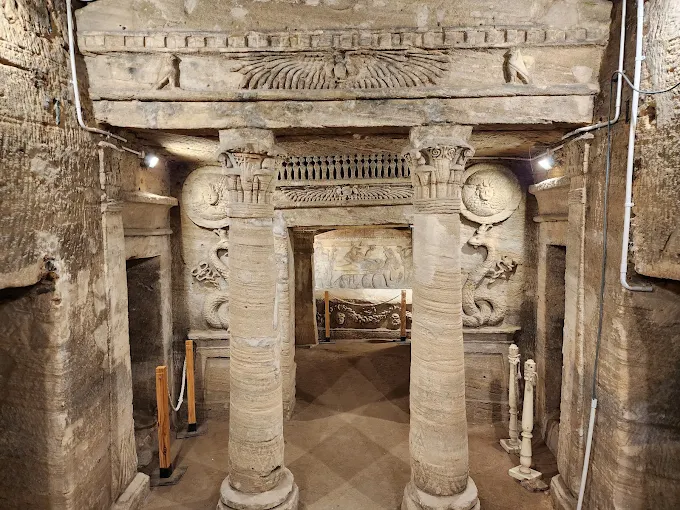
Buried beneath the vibrant streets of the Karmouz district in Alexandria lies one of the Seven Wonders of the Middle Ages: the Catacombs of Kom El Shoqafa. Carved out of solid bedrock during the 2nd century CE during the height of the Roman Empire, this multi-tiered underground necropolis is the largest and most intricate Roman burial site in all of Egypt. Renowned across classical archaeology for its surreal stylistic fusion, Kom El Shoqafa represents a seamless marriage of ancient pharaonic funerary cults with Hellenistic Greek myths and Roman imperial iconography—offering modern travelers an astonishing subterranean glimpse into the cosmopolitan crossroads of ancient Mediterranean civilization.
- Three descending underground tiers descending 35 meters into bedrock via a central spiral staircase.
- Hybrid artistic reliefs: Egyptian funerary deities depicted in classical Roman legionary armor and Greek aesthetic styles.
- The Rotunda and the Triclinium banquet hall, where grieving relatives gathered to feast in memory of the deceased.
- The Hall of Caracalla, containing skeletal remains linked historically to Roman imperial massacres.
- Expedition synergy: Connect your Alexandrian journey with our curated guides to the coastal fortress of the Alexandria City & Qaitbay Citadel, the desert pyramids of the Giza Pyramids Complex, and the monumental mastabas of Saqqara & The Step Pyramid of Djoser.
Subterranean Architecture: The Three Tiers of Kom El Shoqafa
Named “Mound of Shards” after the thousands of terracotta wine jars and food vessels smashed by mourners upon exiting, the necropolis was originally constructed as a private tomb for a wealthy Greco-Roman family before expanding into an extensive public burial labyrinth containing over 300 loculi (wall niches).
The Hybrid Vestibule: Anubis in Roman Armor
Nowhere is the cultural convergence of Alexandria more strikingly illustrated than inside the second-tier vestibule. Framing the doorway of the burial vault are two carved serpents representing the Agathodaemon (good spirit), wearing both the double crown of Upper and Lower Egypt and the caduceus of Greek god Hermes, shielded by the terrifying gorgon Medusa carved into the pediment above. Inside, the jackal-headed embalming deity Anubis is sculpted in high relief dressed not in pharaonic kilts, but outfitted as a Roman centurion in a military cuirass, holding a spear and Roman legionary shield—a stunning visual testament to an era when ancient gods were reimagined through the lens of Roman power.
“In the silent rock of Kom El Shoqafa, Egypt’s eternal pharaohs, Greece’s mythic heroes, and Rome’s imperial legions meet in a single sacred breath.”
The Accidental Discovery & The Hall of Caracalla
Like many great archaeological treasures of Egypt, Kom El Shoqafa was discovered entirely by accident. In September 1900, a donkey pulling a local cart slipped through a sinkhole in the bedrock, plummeting straight down into the long-forgotten subterranean rotunda.
Subsequent excavations uncovered the haunting Hall of Caracalla (also called the Nemeseion), a mass burial chamber containing hundreds of human and equine bones. Historical consensus attributes this mass grave to the infamous 215 CE massacre ordered by the vengeful Roman Emperor Caracalla, who brutally purged the young men of Alexandria following public satires directed at his rule.
Discerning Traveler Practical Tips
- Subterranean Climate & Humidity: While cool compared to summer desert heat, the underground catacombs have high natural humidity. Wear lightweight, breathable cotton clothing and non-slip walking shoes for the wooden access catwalks.
- Cashless Ticketing: The Ministry of Tourism and Antiquities enforces a strict cashless ticketing policy (~200 EGP for foreign visitors). Ensure you carry an international Visa or Mastercard for official gate admission.
- Staircase Navigation: Entry and exit require walking down and up a broad, circular stone spiral staircase comprising over 90 steps. Handrails are installed, but visitors with severe knee issues or mobility challenges should pace themselves accordingly.
- Combine with Pompey’s Pillar: Located less than a 10-minute walk or a 3-minute drive away, Kom El Shoqafa pairs naturally with Pompey’s Pillar and the ancient Serapeum ruins on a morning Alexandrian circuit.
Experience Kom El Shoqafa with Cheers Egypt Tours
Navigating the congested Karmouz quarter of Alexandria and deciphering the complex hybrid mythology of Kom El Shoqafa requires expert scholarly narration and smooth logistical execution. When you book your Alexandria tour with Cheers Egypt Tours, your visit becomes an effortless luxury journey.
You will be guided by certified senior Egyptologists who decode the syncretic Greco-Roman bas-reliefs, explain the funerary rituals of antiquity, and escort you through the chambers away from crowded tour bus waves. With private chauffeured luxury transport directly from Cairo or your Alexandria hotel, pre-arranged fast-track ticketing passes, and bespoke scheduling, Cheers Egypt Tours guarantees a comfortable, regal encounter with one of antiquity’s most intriguing marvels.
Frequently Asked Questions
Why are the catacombs named “Kom El Shoqafa”?
In Arabic, “Kom El Shoqafa” translates to “Mound of Shards.” Ancient mourners who held memorial feasts in the Triclinium considered it bad luck to carry used clay dishes, cups, and wine amphorae back home from the tomb. They deliberately smashed their ceramic vessels on the ground outside upon departing, eventually creating a massive hill of broken terracotta pottery.
Are the Catacombs of Kom El Shoqafa still flooded with groundwater?
No. For decades throughout the 20th century, the lowest third tier was submerged by rising groundwater levels. However, an extensive international engineering and drainage project completed in 2019 permanently lowered the water table, installing raised wooden walkways and modern ventilation systems so that the complex is dry, safe, and accessible.
How long does it take to tour the catacombs?
A typical guided tour takes approximately 1 to 1.5 hours. This provides ample time to descend the spiral staircase, inspect the Triclinium, explore the principal burial chamber with its Roman-clad Egyptian reliefs, and visit the Hall of Caracalla and outdoor sarcophagi courtyard.
Why should I book my Kom El Shoqafa tour with Cheers Egypt Tours?
The catacombs are tucked inside a crowded, narrow neighborhood in Alexandria that can be stressful to reach via standard taxis. Cheers Egypt Tours provides private door-to-door luxury transport, accredited senior Egyptologist guides who explain the intricate Greco-Roman symbology, pre-purchased entrance tickets, and a curated itinerary connecting all of Alexandria’s top coastal sites without hassle.
[EXCERPT] Discover the Catacombs of Kom El Shoqafa in Alexandria with expert Egyptologist insights. Explore the Roman-Egyptian reliefs, the Triclinium, tickets, and luxury private tours with Cheers Egypt Tours. [/EXCERPT]
Our articles are researched and written by licensed master Egyptologists and private VIP concierges with decades of experience escorting international travelers across Egypt.